What it helps identify
A malformed address cannot become deliverable later. Removing structural errors early keeps later checks focused on addresses that could genuinely exist.

Syntax validation checks whether an address follows the structural rules required for email. Addresses with missing parts, invalid characters or impossible formatting can be classified immediately.
Each validation layer answers one defined question. Keeping the scope clear prevents a positive signal from being mistaken for proof of everything else.
A malformed address cannot become deliverable later. Removing structural errors early keeps later checks focused on addresses that could genuinely exist.
Structurally invalid addresses are separated from normal deliverable results with a clear status.
Syntax validation is the deterministic first layer. It separates the local part before the @ sign from the domain after it, then checks whether both parts are present and structurally plausible.
The check looks for problems such as missing components, impossible spacing, repeated separators and characters that cannot appear in the submitted position. Harmless surrounding whitespace can be normalized without rewriting the address itself.
Passing this layer only means that the address is well formed enough to continue. The domain, mail servers and mailbox still need their own checks.
ListCleaner applies the check in a deliberate sequence and retains the original row so the result remains useful in your own system.
Identify the local part and domain around one valid @ separator.
Check length, characters, separators and required domain labels.
Stop impossible addresses early and pass plausible addresses to domain checks.
The exact final status reflects all applicable validation layers. This method contributes the following evidence.
The structure is plausible, so verification continues. This is not yet proof that the mailbox exists.
Unusual but technically possible formatting may deserve review if the source system altered the address.
The address cannot be used as submitted and should not enter a normal sending list.
An entry such as “alex.example.com” has no @ separator and can be rejected immediately. “alex@example.com” is structurally plausible, but it still needs domain, MX and mailbox checks.
Syntax rules cannot tell whether the domain exists, whether its mail servers work or whether a recipient mailbox has been created. A perfectly formatted fictional address can pass this step.
Keep the original value available for correction. Do not silently guess where punctuation or an @ sign belongs, because an automatic “fix” can create a different person’s address.
Email validation describes the evidence available at the time of a check. It does not replace consent, suppression lists or responsible sending practices.
No. It confirms that the address is structurally plausible. Domain and mailbox checks provide the later signals.
No. The service classifies submitted data; it does not guess or silently rewrite an address.
A suggestion can be shown to the person entering the address, but changing it without confirmation can turn one invalid address into a valid address owned by someone else.
Domain names are case-insensitive. In practice most mailbox systems also treat the local part case-insensitively, but ListCleaner avoids relying on capitalization as proof of identity.
ListCleaner exposes email verification and list-cleaning workflows through its API. The returned status summarizes the applicable validation results.
Each page explains one part of the layered workflow and the decision it supports.
Syntax validation checks whether an address follows the structural rules required for email. Addresses with…
Explore this check →Disposable email services issue short-lived inboxes that people can abandon immediately. ListCleaner compares domains with…
Explore this check →Spam traps are addresses used to identify poor acquisition or sending practices. ListCleaner checks submitted…
Explore this check →Complaint activity can affect sender reputation and inbox placement. This layer checks addresses against internal…
Explore this check →Mail exchanger records tell sending systems where a domain expects to receive email. ListCleaner checks…
Explore this check →Domain validation evaluates the domain portion of an address and its supporting DNS signals. It…
Explore this check →Catch-all mail systems can appear to accept any address at a domain, including addresses that…
Explore this check →Hard-bounce risk can come from nonexistent mailboxes, inactive accounts or permanent domain failures. ListCleaner combines…
Explore this check →Tor exit nodes can obscure the originating network of an account or submission. This method…
Explore this check →Upload a supported file, select its email column and follow progress in your dashboard.
A marketer-friendly guide to interpreting email verification results and turning each finding into a documented campaign decision.
Read article →A practical 12-step email list cleaning checklist for marketers preparing a newsletter, launch or re-engagement campaign.
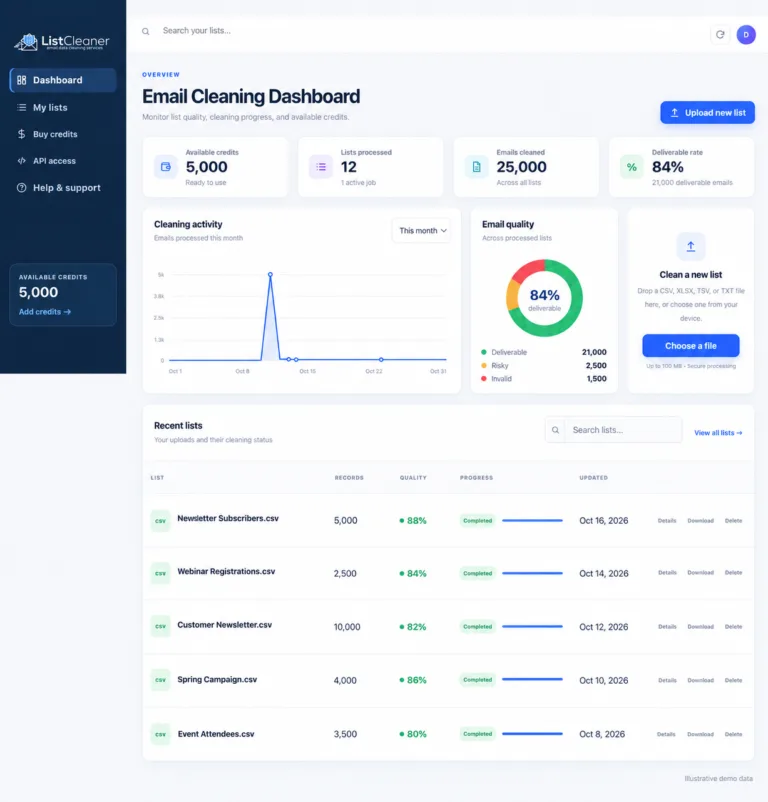
Read article →Explore the new ListCleaner dashboard for uploads, cleaning activity, email-quality summaries, recent lists, credits and API access.
Read article →